Antares Throat is a physical modeling voice designer that lets you sculpt vocal qualities by manipulating a realistic model of the human vocal tract, offering precise control over sound and texture.
Purpose and Core Concept
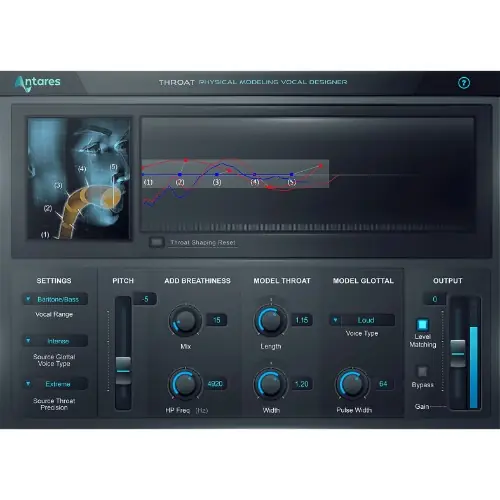
Throat is a virtual instrument that models the entire human vocal tract, providing a hands-on approach to shaping vocal characteristics. It is designed for music producers, sound designers, and vocalists who want to go beyond standard effects and directly influence the physiological elements that create voice. The tool focuses on adjusting the tract’s geometry, including length, width, and constriction, to achieve a wide range of timbres.
The core idea is to offer both subtle refinements and extreme transformations, making it suitable for natural vocal corrections or creative, avant-garde sound design. By addressing the physical source of vocal production, Throat avoids the artificial artifacts often associated with traditional pitch or formant processing.
Key Capabilities and Controls
The interface provides direct manipulation over the glottal waveform, which is the raw signal generated by the vocal folds. Users can adjust the shape and texture of this waveform to change the fundamental character of the voice, from clean to gritty. In addition, the length and width of the vocal tract can be modified, which affects formant frequencies and overall resonance, allowing for realistic gender or age changes.
Constriction controls let you narrow or widen specific parts of the tract, producing effects like nasal quality or choking. Pitch shifting is integrated, offering up to an octave in either direction, which can be combined with tract adjustments to create diverse vocal personas.
Workflow and Integration
Throat is available as a plugin in AAX Native, VST3, and Audio Units formats, supporting recent Windows and macOS systems. It requires a compatible host, such as Pro Tools 2018.1 or later for AAX, or any modern VST3/AU host. The plugin does not require serial activation; after purchase, you simply download the installer and use it directly.
In a typical workflow, you load Throat on a vocal track, then experiment with the tract model in real time. The controls are designed for automation, so you can create dynamic changes over a phrase, such as gradually opening the throat for a brighter tone or adding constriction for tension.
Practical Applications
Throat is ideal for adding realistic breathiness to vocals, controlled via customizable frequency noise, which can make performances more intimate or airy. It also excels at generating harmonically rich textures, blending vocal-like qualities into synthetic sounds. For podcast or audiobook production, it can subtly adjust a voice to better fit a character.
In music production, it can be used to create backup vocal variations, design futuristic voice effects for electronic music, or repair a weak take by adding fullness without harsh processing. The ability to morph between vocal styles opens up creative possibilities in sound design for film and games.
Key features
- Complete model of the human vocal tract
- Glottal waveform shaping
- Adjustable tract length, width, and constriction
- Breathiness control with frequency noise
- Pitch shifting up to one octave up or down
- Subtle to extreme vocal modifications
Best for
Best for music producers, sound designers, and vocalists seeking a physical modeling approach to vocal manipulation, offering intuitive control over breath, timbre, and pitch for both realistic adjustments and extreme creative effects.