aXDeesser is an ambisonic de-essing plugin that applies frequency-band compression to AmbiX signals, with sidechain triggering from a steerable virtual microphone for spatial control.
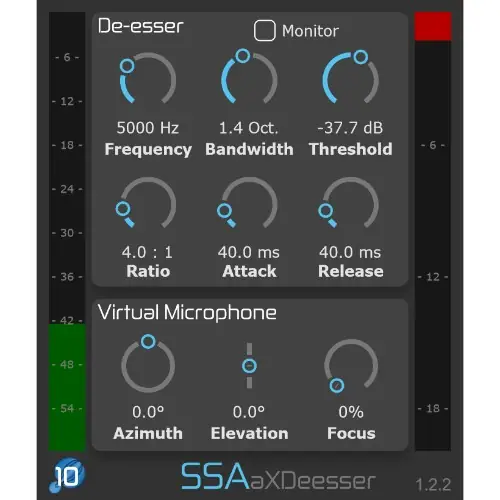
Purpose and Signal Processing
aXDeesser functions like a traditional de-esser but operates on AmbiX (ACN/SN3D) ambisonic audio. It compresses a user-defined sibilance frequency band, reducing harsh ‘s’ sounds in immersive mixes. The plugin integrates directly into ambisonic workflows, preserving the spatial integrity of the signal while taming vocal sibilance.
The compressor’s sidechain can be driven by a virtual microphone, so de-essing activates only when sibilance arrives from a specific direction in the scene. This spatial targeting distinguishes it from stereo de-essers, allowing the engineer to treat dialogue or vocals without affecting ambisonic ambience coming from elsewhere.
Spatial Sidechain and Virtual Microphone
The virtual microphone’s azimuth and elevation can be set to point at any location in the immersive field. Its directivity is controlled via the Focus parameter, making the sidechain more or less directional. This enables precise triggering, e.g., pointing at a speaker’s position while ignoring reflections or other sources.
The sidechain signal is used only to trigger the compressor, not to affect the audio path. The practical workflow involves aligning the virtual mic’s direction with the sibilant source, then adjusting the focus to widen or narrow the acceptance angle. This is especially useful in binaural or surround dialogue scenes where off-axis sibilance would otherwise cause unwanted gain reduction.
Compression Controls and Monitoring
Standard de-esser controls include Frequency (center of the band to compress), Bandwidth (in octaves), Threshold (level at which compression begins), Ratio (compression strength above the threshold), Attack and Release (time constants in milliseconds). These allow tailoring of the response to the specific sibilance characteristics.
A Monitor Sibilance Band feature lets you solo the relevant band to audition exactly what is being compressed. This helps in fine-tuning the frequency and bandwidth, ensuring that only the sibilance range is targeted without dulling the overall signal. The compressor behaves transparently when set with appropriate ratios and timings, reducing harshness while preserving vocal clarity.
Ambisonic Order Handling and Workflow
The plugin automatically detects the ambisonic order of the input signal and adjusts its internal processing accordingly. This means no manual selection is needed, and CPU usage is optimized when working with lower-order ambisonics. It can handle up to tenth-order ambisonics, though the actual maximum depends on the DAW’s channel capacity.
In typical projects, the engineer inserts aXDeesser on an ambisonic bus or track, then uses the virtual mic to focus on dialogue. The automatic order detection simplifies setup across various ambisonic projects, from first-order recordings to higher-order productions. The plugin outputs AmbiX in the same order as the input, seamlessly integrating into existing ambisonic pipelines.
Key features
- Virtual microphone sidechain with azimuth, elevation, and focus control
- Frequency, bandwidth, threshold, ratio, attack, and release controls
- Monitor sibilance band for focused audition
- Ambisonic order detection for automatic CPU optimization
- Supports up to tenth-order ambisonics (DAW dependent)
- Input and output in AmbiX (ACN/SN3D) format
Best for
Ideal for post-production engineers and immersive audio creators who need to reduce sibilance in dialogue or vocals within ambisonic projects, especially when the source is localized. Its virtual mic sidechain makes it suited for scenes with off-axis sibilance or when preserving spatial ambience is critical.