aXEqualizer is an eight-band equalizer for sculpting the tone of Ambisonic signals up to tenth order, with controls similar to a stereo EQ. It preserves spatial balance while offering familiar filter types and bypass options.
Purpose and Design
aXEqualizer targets Ambisonic audio mixing and mastering, allowing engineers to shape the frequency spectrum of immersive scenes without disrupting their spatial integrity. The plugin applies equalization to the entire Ambisonic field, maintaining the spatial relationship between sound sources. Its interface mirrors the workflow of a conventional stereo equalizer, making it accessible to those familiar with standard EQ operation.
The equalizer processes signals up to tenth order, supporting the highest spatial resolution available in current DAWs. It automatically detects the Ambisonic order of the input signal and optimizes CPU usage accordingly, which is efficient for lower-order projects. Input and output formats are identical, ensuring that the plugin does not alter the channel layout or require additional configuration.
Key Capabilities
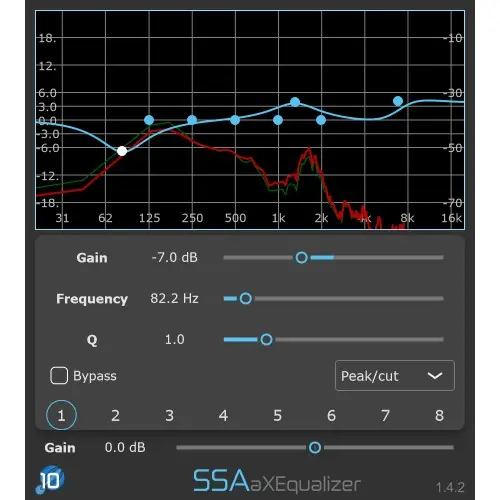
The plugin features eight filters arranged in series, each with individual bypass controls. Users can choose from six filter types: high shelf, low shelf, peak, notch, high pass, and low pass. For each band, the frequency, gain, and Q-factor are adjustable, enabling precise tonal shaping. The Q factor controls the roll-off steepness or filter width, while gain determines the amount of boost or cut.
A master output gain is also provided, allowing for level adjustments after processing. The interface allows direct manipulation by dragging markers on a spectrum display, giving immediate visual feedback of changes. This visual approach speeds up the equalization workflow, making it easy to locate and adjust problematic frequencies or to creatively sculpt the spectrum.
Workflow and Control
Operating aXEqualizer follows the same logic as a stereo EQ: you select a band, choose a filter type, then adjust its frequency, gain, and Q. The drag-and-drop marker system simplifies parameter changes, that you can make quick adjustments while monitoring the spectrum display. The bypass controls for each band allow A/B comparisons and fine-tuning of individual filters without affecting the rest.
The plugin’s automatic Ambisonic order detection removes the need for manual configuration, adapting to the input signal’s order and saving CPU resources. This is particularly useful when working on projects that mix different orders or when rendering in a DAW that supports varying channel counts. The output remains in the same format as the input, so the plugin can be inserted at any point in the signal chain without format conversion.
Practical Applications
aXEqualizer is suitable for mixing and mastering immersive audio content for VR, film, games, and music. It can be used to correct tonal imbalances in an Ambisonic recording, such as taming harsh frequencies or boosting warmth. The high-pass and low-pass filters help clean up low-frequency rumble or excessive high-frequency energy, while peak and notch filters address specific resonances.
In post-production, the plugin helps match the spectral characteristics of different Ambisonic sources, ensuring a cohesive mix. When used on a master bus, it applies a global tonal adjustment to the entire scene. The high-order support makes it a tool for demanding immersive projects, but its familiar controls also make it suitable for beginners exploring spatial audio.
Key features
- Eight filters in series with individual bypass
- Six filter types: low shelf, high shelf, peak, notch, high pass, low pass
- Adjustable frequency, gain, and Q factor per band
- Master output gain control
- Automatic Ambisonic order detection for CPU optimization
- Supports up to tenth-order Ambisonics
- Drag markers on spectrum for quick parameter changes
Best for
Mixing and mastering Ambisonic audio scenes where preserving spatial relationships is critical. Ideal for immersive music producers, VR audio engineers, and post-production specialists who need familiar EQ controls to shape the spectrum of high-order Ambisonic content without manual order mapping.