A real-time volume leveler/rider for keeping dialog, vocals, podcasts, streams, or program material within a target loudness range automatically, with configurable timing, weighting, sidechain, and limiting. Designed for set-and-forget operation.
Core Purpose
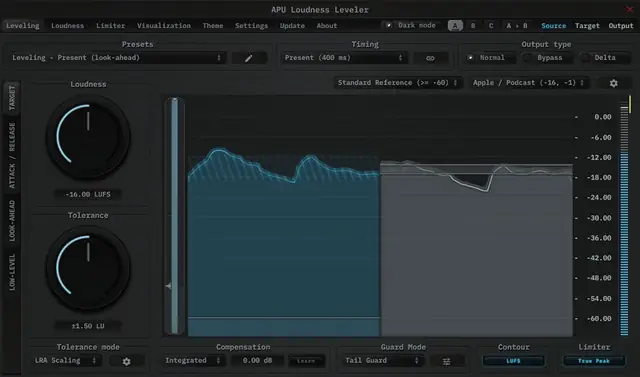
APU Loudness Leveler continuously measures audio loudness and applies gain correction in real time to stay near a user-defined target level. Set a target loudness and tolerance; the leveler adjusts gain dynamically as the signal drifts outside the allowed zone. It is built for dialog, vocals, podcasts, streams, and general program material.
The leveler offers multiple timing modes that determine the detector family and response character. Tight uses a 25ms LUFS window for fast, note-by-note riding; Focus uses 100ms for assertive phrase-level correction; Present uses a 400ms momentary window for smooth general-purpose leveling; Deep uses a 3-second short-term window for broader contour following; Traditional uses a 300ms RMS detector for classic dynamics behavior.
Key Capabilities
The Leveling tab centers on target loudness and tolerance with three tolerance behaviors: a dead zone, an LRA-aware scaling region, or an LRA-based adaptive mechanism. Guard modes prevent boosting into tails or cutting into transients by holding gain correction outside percentile thresholds. Sidechain modes can engage, disengage, or drive the leveler externally, and low-level handling can keep leveling active, bypass, or gate quiet material.
Max cut and max boost bounds keep correction practical. Standard timing modes use real look-ahead, while low-latency variants use predictive virtual look-ahead to approximate the same without added delay. Channel Link options allow linked operation preserving stereo/surround image or split operation correcting inter-channel imbalances.
Workflow and Controls
Gain Correction is for final-pass precision: choose Average or Integrated, run a representative pass with learning enabled, then lock the learned value for playback or delivery. The stored correction is a global dB offset added on top of the rolling leveler behavior, complementing rather than replacing target, tolerance, guard, or limiter controls. Learn, Lock, and Reset streamline the process.
Dual targets allow a secondary loudness zone for sidechain-triggered or low-level behavior. Primary target remains the normal range; secondary can take over or blend via sidechain Engage/Disengage modes or Low-Level Target mode. Alternate weighting curves (ECMA-418, ITU-R 468, A-weighting, C-weighting) change detector frequency response, implemented as zero-latency IIR filters.
Applications and Integration
Detector EQ shapes the signal used for loudness detection without altering the audible output (unless monitor enabled). It includes low-pass and high-pass filters with selectable slopes, a parametric mid band with bell/shelf/band-pass shapes, trim and mix controls, and monitor modes. The built-in limiter scans look-ahead region for peak or true-peak excursions and adjusts gain trajectory to keep output under the ceiling.
Practical uses include live streaming, podcast recording, voiceover sessions, and music program leveling where consistent loudness is needed without manual gain riding. Deep mode suits music, Tight or Focus suits fast instrumental or dialog with precise gestures, and Traditional suits classic dynamics. The leveler can be used in real-time or for final-pass delivery with learned correction.
Key features
- Real-time volume leveling with target loudness and tolerance
- Five timing modes: Tight, Focus, Present, Deep, Traditional
- Optional dual targets for sidechain and low-level behavior
- Sidechain control with engage/disengage and drive modes
- Guard modes to protect transients and tails
- Detector EQ with filters and monitor options
- Built-in limiter with peak/ture-peak look-ahead
- Alternate weighting curves: ECMA-418, ITU-R 468, A-weighting, C-weighting
Best for
Best for engineers and content creators who need automatic, real-time loudness control for dialog, vocals, podcasts, streams, or music program material, especially in broadcast, streaming, or post-production workflows where consistent loudness is critical without constant manual adjustments.