DrMS is a spatial audio processor for mixing, mastering, and post-production, offering mid-side encoding/decoding, stereo width and depth control, and mono compatibility fixes.
Purpose and Core Function
DrMS is a unique spatial processor designed to give you detailed control over the stereo field. It goes beyond simple width adjustments, offering a range of tools for mixing, mastering, and post-production. At its heart, it can perform standard MS (Mid-Side) encoding and decoding, which is a foundational technique for stereo manipulation.
Beyond basic MS processing, DrMS allows you to enhance the perceived width and depth of your audio. It also addresses practical issues like mono compatibility, ensuring your mixes translate well across different playback systems. This makes it a versatile utility for both creative sound design and technical problem-solving.
Key Capabilities and Processing Sections
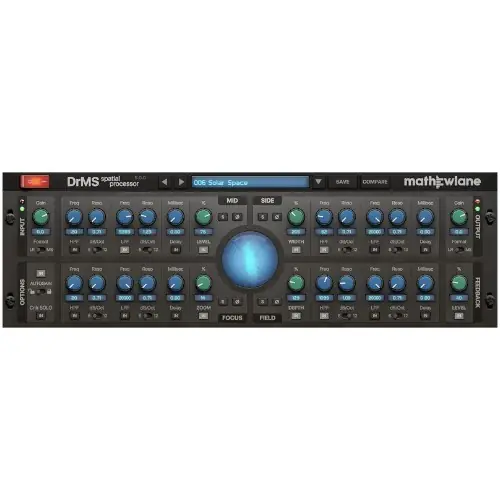
The plug-in features four distinct processing sections, each equipped with mastering-grade filters, including resonant high-pass and low-pass filters, as well as a delay. This allows for precise frequency-specific spatial adjustments. A feedback circuit is also included, enabling reverb creation and special effects that expand the sonic possibilities beyond simple stereo tools.
An integrated autogain circuit simplifies level-matched A/B comparisons, so you can accurately evaluate the effect of your changes. The graphical user interface includes a central phase scope and allows for manual entry of parameter values, giving you both visual feedback and precise control. A built-in preset management system allows you to exchange presets between different hosts and platforms.
Workflow and Integration
In a mixing workflow, DrMS can be used on individual tracks or buses to widen instruments or create depth in a mix. For mastering, it helps fine-tune the overall stereo image and address mono compatibility. In post-production, it can be used to reposition elements or enhance dialogue intelligibility. The plug-in’s presets, designed by professionals, provide a quick starting point for various scenarios.
The new underlying framework ensures compatibility with the latest OS and DAW versions. It supports both native AAX, AU, VST2, and VST3 formats. For authorization, it requires an iLok account and an iLok2 or higher USB dongle, with machine-based licensing also available. Each license includes two activations, allowing use on multiple systems.
Practical Applications and Limitations
Practical applications include widening a stereo track that feels too narrow, adding depth to a reverb send, or fixing phase issues that cause mono compatibility problems. The delay and feedback sections can create interesting spatial effects that are not possible with standard stereo tools. The manual entry of parameters is useful for precise recall of settings.
It is important to note that DrMS requires a host DAW and does not function as a standalone application. The plug-in is compatible with macOS (including Apple Silicon via Rosetta 2) and Windows. While the source mentions RTAS support via an older version, the current version focuses on native formats. The iLok authorization system is a requirement, which may not suit all users.
Key features
- MS encoding/decoding and stereo field manipulation
- Four processing sections with resonant filters and delay
- Feedback circuit for reverb creation and effects
- Autogain circuit for level-matched A/B comparisons
- Central phase scope for visual feedback
- Preset management and professional presets
Best for
DrMS is best for audio professionals seeking a comprehensive spatial processor for mixing, mastering, and post-production, offering both technical mono-compatibility fixes and creative width/depth enhancement, with precise control via filters and delay.