Expanse 3D is a psychoacoustic space enhancer from JMG Sound that widens, deepens, and heightens audio using saturation, spectral phase processing, and delay networks for mixing, mastering, and sound design.
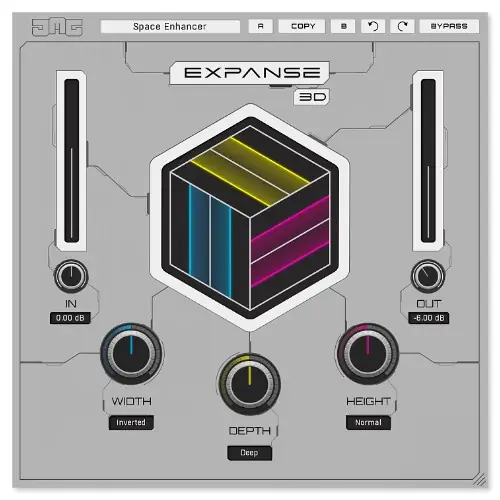
Purpose and Core Concept
Expanse 3D is designed to expand the perceived three-dimensional space of audio, moving beyond traditional stereo width to add depth and height. It applies a combination of analogue-type saturation, spectral phase offsetting, re-synthesis, and intricate delay networks to create a supermassive sound. The plugin is suitable for mixing, mastering, and sound design, helping to glue elements together or create contrast and definition within a mix.
The core idea is to make music sound deeper, wider, and bigger without compromising transparency. It uses advanced psychoacoustic techniques to enhance the spatial characteristics of a signal, making it feel more immersive and expansive. The processing is frequency-dependent, with filters that ensure zero phase shift and no latency, making it appropriate for mastering contexts.
Key Capabilities: Width, Depth, and Height
The widener uses a spectral phase processor to create super width while remaining natural and transparent. It keeps bass tight, reduces stereo from the sub frequencies, and progressively widens toward the high end. It is fully mono-compatible, preserves position focus, and can generate stereo from mono sources, making it versatile for various track types.
For depth, Expanse 3D employs a complex algorithm of delay networks with channel and phase processing to enhance the perception of space. It adds definition and punch to the front while extending the back, creating dynamic contrast between sounds and helping to glue multiple elements together for a more cohesive mix. This depth processor is particularly useful for full mixes when used subtly.
Workflow and Practical Applications
In a mixing workflow, Expanse 3D can be used to define individual tracks by positioning them in the three-dimensional space. You can widen two sounds with one inverted to separate them, create dynamic depth between deep and shallow elements, and brighten sounds to make them stand out. This helps each part maintain its own identity within a complete, dynamic mix.
For mastering, applying Expanse 3D subtly can improve the overall impact and energy of the master, making it sound bigger and more exciting. The widener is sympathetic to each frequency, preserves stereo focus, and is mono-compatible. The additional harmonics add clarity, and the auto gain function allows changes without altering loudness, ensuring the mix becomes more cohesive as parts share a common space.
Technical Notes and Limitations
Expanse 3D uses internal 64-bit audio processing and can handle any sampling rate, including very high rates. It includes an intelligent bypass that prevents clicks or noises when automating parameters, and it compensates for latency to keep bypass states in sync. There is also an intelligent sleep-on-silence feature that reduces CPU usage when processing is not needed, saving resources for other tasks.
The plugin implements finely tuned saturation modeled on analogue distortion, capturing harmonic distribution, dynamic consistency, non-linear randomness, and anti-aliasing algorithms to add warm color. It also features up to 8x oversampling for high-quality saturation. Activation uses license files, requiring no iLok, dongle, or internet access, and you can use the software on all your computers as long as you are the user.
Key features
- Psychoacoustic 3D expansion for width, depth, and height
- Spectral phase processing for natural, transparent width
- Delay networks with channel and phase processing for depth
- Harmonic generation for extended bass and treble without EQ boosts
- Analogue-modeled saturation with anti-aliasing
- Zero phase-shift filters with no latency
- Auto gain function to maintain loudness
Best for
Expanse 3D is best for producers, mixers, and mastering engineers who want to add spaciousness and dimension to their tracks. It excels at widening mono sources, gluing full mixes together, and creating contrast between elements. It is particularly effective for genres where a large, immersive sound is desired, such as electronic, cinematic, or pop music.