OD DeEdger is a threshold-free audio plugin for reducing signal hardness without altering original qualities. It detects and smooths harshness transparently, suitable for mastering and mixing. Set-and-forget design with low CPU load.
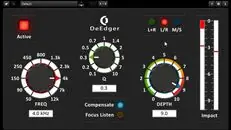
Purpose and Core Concept
OD DeEdger addresses a common audio problem: excessive hardness in sound. Unlike traditional dynamics processors that rely on thresholds, it operates in a threshold-free manner, meaning it can handle any input level, type, or dynamic range without manual adjustment. The plugin only applies processing when hardness is detected, avoiding under- or over-processing that can compromise the signal.
The concept was developed by a professional mastering engineer, Jan Ohlhorst, for the demands of modern mastering. Its transparent processing is equally useful in mixing, making it a versatile tool for engineers seeking to tame harshness while preserving the original character and musicality of the audio.
Key Capabilities
DeEdger uses intricate time- and frequency-dependent mechanisms to deliver a transparent process. It smooths detected hardness with elegance, ensuring that the reduction in sharpness does not introduce audible artifacts. This allows it to preserve dynamic impact, so tracks retain their punch and energy even after processing.
The plugin is suitable for complex stereo material, including individual tracks and subgroups. Whether applied to a single vocal or a full mix bus, it can help reduce listener fatigue without dulling the mix. Its low CPU load makes it practical for use across many instances in a session.
Workflow and Use
After initial setup, DeEdger can be left in a set-and-forget configuration. It requires no continuous attention, as it automatically adapts to the material. This is ideal for mastering chains where consistency and reliability are paramount, and for mixing engineers who want a robust tool without constant tweaking.
To use it effectively, insert DeEdger on a track or bus, adjust the hardness reduction to taste, and trust the threshold-free detection to respond appropriately. It works well on both individual elements and full mixes, making it a flexible addition to any processing workflow.
Practical Applications
In mastering, DeEdger can be used to smooth overly bright or harsh recordings while maintaining the mastering engineer’s ability to maintain loudness and dynamics. It is particularly useful for modern music productions that often exhibit digital harshness from synthesizers, distortion, or poor recording chains.
In mixing, it can be applied to problematic tracks like vocals, cymbals, or guitar amps to reduce harshness without heavy-handed EQ or dynamics. Its transparency means it can be used on subgroups or the mix bus to glue elements together without altering their tone significantly.
Key features
- Threshold-free operation adapts to any input level and dynamic range
- Detects and smooths hardness only when present, avoiding over-processing
- Preserves dynamic impact and musicality
- Intricate time and frequency-dependent mechanisms for transparency
- Suitable for complex stereo material, tracks, and subgroups
- Low CPU load
- Intuitive user interface with set-and-forget design
Best for
OD DeEdger is best for mastering and mixing engineers who need to transparently reduce harshness in audio without compromising dynamics. Its threshold-free design makes it an excellent choice for handling variable input levels, and its low CPU load allows for use across multiple tracks or on a mix bus.