SplitEQ is an eight-band parametric EQ that separates audio into transient and tonal streams for independent correction, creative shaping, and stereo widening, offering a new approach to mixing and repair.
Purpose and Core Concept
SplitEQ redefines equalization by splitting incoming audio into two distinct streams: transients and tonal elements. This structural split lets you address problems like sibilance, plosives, or harsh attacks separately from sustained tones, harmonics, and ambience, avoiding the compromises of traditional EQ.
You can apply filters to the entire signal or target just one stream. For example, soften a kick drum’s boom without losing its thump, or reduce snare ring by filtering only the tonal mids. This approach simplifies workflows that previously required multiple processors like compressors, de-essers, or dynamic EQ.
Key Capabilities
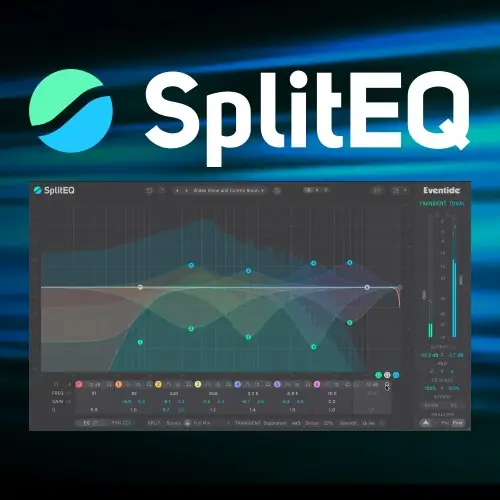
SplitEQ features eight bands of musical filters, including peak, notch, high and low shelf, tilt shelf, and pass filters with slopes up to 96 dB per octave. The real-time spectrum analyzer displays transient and tonal streams separately, helping you pinpoint resonances or problematic transients with precision.
The split controls allow fine-tuning of the separation algorithm to extract the exact transient or tonal character you need. Global scaling of EQ curves is possible, along with independent control of transient and tonal output levels. A/B comparison and undo/redo facilitate quick experimentation.
Workflow and Integration
SplitEQ supports L/R and Mid/Side panning for each band’s transient and tonal components, enabling precise stereo imaging. You can widen a beat, place instruments in the mix with clarity, or adjust the balance between attack and sustain without affecting the rest of the signal.
The interface is resizable, and the graphical display offers multiple monitoring options. Peak and RMS metering provide additional insight. A factory library of over 150 presets covers common corrective and creative tasks, such as enhancing vocals, repairing drums, rebalancing guitars, and widening mixes, making it suitable for individual tracks, full mixes, or two-track loops.
Practical Applications
SplitEQ excels at four primary tasks: enhance, repair, rebalance, and widen. You can add punch or sheen to instruments, remove unwanted boom or buzz, soften strumming while boosting amp reverb, or spatially manipulate frequency bands for creative effect.
It works on a wide range of material, including poorly recorded tracks, proving its value in restoration. Whether you’re cleaning up a vocal, fixing a kick drum, or crafting a unique stereo image, SplitEQ offers a musical and intuitive way to shape sound without losing its original character.
Key features
- Structural Split separates transient and tonal components
- Eight-band parametric EQ with musical filters
- Independent transient and tonal output level controls
- Continuous L/R and Mid/Side panning for each band
- Real-time spectrum analyzer displaying streams separately
- Over 150 factory presets for corrective and creative tasks
- Resizable GUI with A/B comparison and undo/redo
Best for
SplitEQ is best for audio engineers and producers who need surgical yet musical EQ for corrective work on problematic recordings, creative sound design, and stereo widening. It’s ideal for mixing drums, vocals, and guitars, or for cleaning up loops and full mixes without losing the original character.