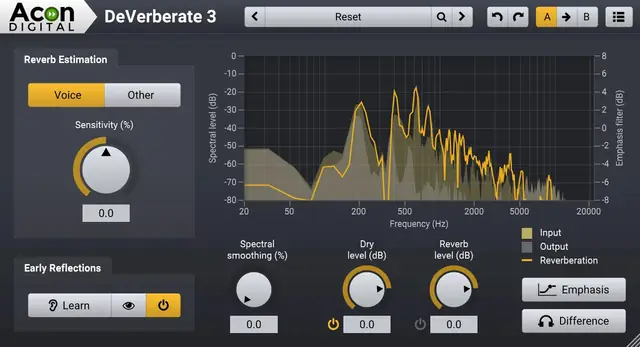
DeVerberate 3 is a reverb reduction plugin that uses deep learning for automatic dialogue cleanup and a classic algorithm for music, plus an Early Reflections Filter for precise control.
Purpose and Core Technology
DeVerberate 3 is a dedicated reverb reduction plug-in designed to attenuate or boost reverberation already present in recorded audio. Its primary focus is dialogue cleanup, leveraging a new deep-learning algorithm that separates speech from room acoustics. Trained on thousands of voice recordings across diverse environments, the neural network automatically distinguishes direct sound from reverberation.
For music and other audio material, the proven algorithm from version 2 remains available, ensuring flexibility across different source types. Both methods split incoming audio into estimates of direct and reverberated components, which users can recombine freely to adjust the reverb level. This makes the plugin suitable for post-production, broadcasting, and any scenario where reducing unwanted ambience is critical.
Key Features and Processing
A unique Early Reflections Filter complements the suppression algorithms. It uses statistical methods to estimate the impulse response of early reflections, then cancels their effect, which is essential for taming slap echoes or close-wall reflections that muddy dialogue. The filter works in conjunction with the reverb reduction engines, offering finer control over the initial sound decay.
Both the deep-learning and classic algorithms allow users to adjust the mix of direct and reverberated signals. This enables not only reduction but also creative boosting of ambience if desired. The plugin’s interface is straightforward, focusing on parameter adjustments for the direct/reverb balance, with the AI performing automatic separation in the background, minimizing manual tweaking.
Workflow and Host Integration
DeVerberate 3 integrates into standard audio editing environments as a plug-in. It is available in VST, VST3, and AAX formats for Windows, plus AU, VST, VST3, and AAX for macOS. The Windows versions include both 32-bit and 64-bit builds, while macOS runs natively on ARM and Intel processors. A compatible host application is required to operate the plug-in.
Typical workflows involve inserting the plug-in on a dialogue track, letting the automatic algorithm process the audio, and then manually fine-tuning the direct/reverb mix. For music, users can switch to the version 2 algorithm and adjust settings to taste. The Early Reflections Filter can be engaged separately to target specific reflection patterns, making the tool adaptable to different room acoustics and recording conditions.
Practical Applications and Limitations
DeVerberate 3 is ideal for cleaning up location dialogue in film and video production, where reverb from rooms or outdoor environments can reduce intelligibility. It also proves useful for podcast and voiceover sessions recorded in untreated spaces, as well as for music recordings where ambient bleed is unwanted. The ability to boost reverb opens creative possibilities for adding space artificially.
Users should note that the deep-learning algorithm is optimized for speech, so for music the classic algorithm is recommended. The plug-in requires a host application and a system meeting specified hardware; Windows 7 or later and macOS 10.9 or later are supported. Performance may vary depending on CPU power, with 1 GB RAM minimum but 4 GB advised for smooth operation.
Key features
- Deep learning algorithm for automatic dialogue reverb reduction
- Classic algorithm for music and other audio sources
- Early Reflections Filter with statistical impulse response estimation
- Separate estimation and free recombination of direct and reverberated sound
- Support for VST, VST3, AAX on Windows and macOS, plus AU on macOS
- Native ARM and Intel support on Mac, 32/64-bit on Windows
Best for
DeVerberate 3 is best for post-production professionals cleaning dialogue in films, podcasts, or broadcasts, and for music producers needing to tame ambient reverb. It excels in automatic speech processing with manual override, making it a versatile tool for reducing unwanted room acoustics or creatively adding space.