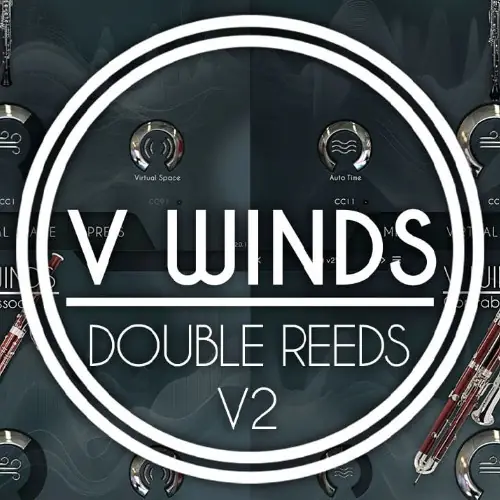
VWinds Double Reeds is a hybrid sampled-modeled collection of seven double reed instruments, offering expressive control through airflow and advanced H.A.T. technology for realistic performances.
Purpose and Instrument Lineup
VWinds Double Reeds is a virtual instrument bundle from Acousticsamples, designed to bring realistic double reed sounds to composers and producers. It includes seven instruments: two oboes, two English horns, two bassoons, and one contrabassoon. Each version of the first three instruments was recorded separately with different world-class musicians, providing a variety of tonal colors.
The collection is built on a hybrid technology that blends recorded samples with physical modeling. This approach aims to deliver authentic, expressive performances without relying on extensive key switches or multiple MIDI controllers. The goal is to make these instruments immediately playable, allowing musicians to focus on musical expression rather than technical setup.
Core Technology and Control
At the heart of VWinds Double Reeds is proprietary Harmonic Alignment Technology (H.A.T.). This technology is said to reproduce each instrument’s timbre with high accuracy across the full dynamic range and every articulation. It enables continuous response and customizable performance techniques, such as legato transitions and vibrato, giving users expressive control that mimics a live player.
Articulations are controlled primarily through airflow, which can be played live with a MIDI controller or drawn as automation. There are no complicated key switches for staccato or legato; instead, the player shapes the performance intuitively. Vibrato is automated by default but can be adjusted or controlled manually. The legato behavior includes various transition speeds and can be randomized for a more human feel.
Workflow and Interface
The interface is designed to be user-friendly, with controls for airflow, vibrato, and legato settings. Users can adjust the vibrato to be automatic, time-dependent, or fully manual. The legato transitions can be customized to include extra attack or be slower or faster, and randomization adds variety. This allows for detailed phrasing without the need for complex programming.
Microphone placement is handled with three different positions, offering flexibility in shaping the sound. The ‘virtual space’ feature can be used with the multi-microphone setup to create a sense of depth. This workflow suits producers who want to dial in a specific character or blend the instrument into a mix, with EQ and reverb applied as needed.
Practical Applications
VWinds Double Reeds is suitable for film scoring, orchestral arrangements, and any genre requiring expressive woodwinds. The library’s ease of use makes it ideal for sketching ideas quickly, while the detailed controls support refined production. The variety of instruments and tonal colors allows for section writing or solo passages with distinct characters.
The compact size (about 100 MB per instrument) and efficient hybrid engine make it practical for sessions with limited storage or processing power. The included presets and retina graphics add convenience. Musicians can achieve realistic legato and vibrato without manual editing, which is useful for live performances or MIDI-based compositions where realism is crucial.
Key features
- Seven double reed instruments: 2 oboes, 2 English horns, 2 bassoons, and 1 contrabassoon
- Hybrid sampling and modeling technology with H.A.T. for accurate timbre and response
- Airflow-based articulation control with no key switches needed
- Multiple vibrato modes: automatic, time-dependent, and manual
- Customizable legato transitions with randomization for human-like performance
- Three microphone positions for flexible sound shaping
- Compact size: approximately 100 MB per instrument
Best for
VWinds Double Reeds is best for composers and producers needing realistic double reed sounds for orchestral mockups, film scores, or live MIDI performances. Its intuitive airflow control and expressive legato make it suited for musicians who prefer playing parts in real time rather than programming details, while detailed mic and vibrato options cater to advanced sound design.