Brood is a dual-voice orchestral ROMpler for Kontakt 5.8.1+, offering dark, evolving soundscapes via a unique sequencing engine with deep modulation and morphing controls.
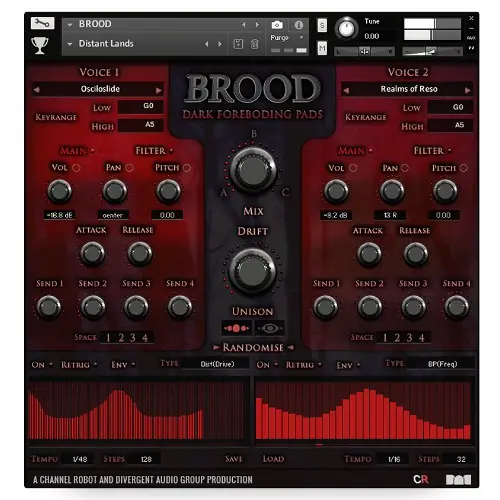
Purpose and Character
Brood is a dual-voice orchestral sample player for Kontakt, designed to deliver uneasy, dark, and unpredictable atmospheres. Its 150 custom audio sources and 2,140 samples form a library focused on unsettling textures, strange fragments, and brooding soundscapes. The instrument excels at creating non-repeating, evolving sonic backgrounds.
Using Audio Reward’s DOSA engine, playback subtly shifts over time, ensuring each performance feels unique. This approach replaces labor-intensive manual editing with an automated, living sound. It is well-suited for film scoring, horror, or ambient work where motion and instability are desired.
Core Capabilities
At its heart, Brood offers two independent voices that can be mixed together, providing layered complexity. Each voice includes dedicated drift controls for pitch variation, creative filter options, and modulation routing. A unique gate sequencer per voice adds rhythmic or random gating effects, while four send effects per voice expand spatial possibilities.
Additionally, the instrument features three scene controls (A, B, C), each saving volume, pan, and pitch settings. You can morph smoothly between scenes for dynamic shifts in texture. The multi-key sequencer allows eight sequencers to run simultaneously—one per pressed key—adding complex, interaction-driven patterns.
Workflow and Operation
Operating Brood is straightforward: select a set of voices and play. The DOSA engine continuously generates subtle variations, so a single performance provides evolving output without manual retriggering. You can assign different voices to separate keys or layers, then blend them using the dual-voice architecture.
For articulation changes, use the scene morphing to vary volume, pan, and pitch across three presets during a performance. The gate sequencers and modulation controls allow rhythmic or chaotic patterns per voice. This design suits both prepared playing and experimental, gestural control within a Kontakt session.
Practical Applications
In practice, Brood is ideal for creating unsettling, evolving beds for film scenes, games, or podcast ambience. Its unpredictable nature suits horror, thriller, or abstract electronic music where repetition is undesirable. The dual-layer voices allow contrasting textures—like a low drone paired with sparse metallic fragments—to be played together.
For sound designers, the gate sequencer and modulation controls offer rhythmic or random articulation without external automation. The scene morphing enables live changes between tense, sparse, and dense states. Since it never repeats exactly, each take yields new material, valuable for generating original source audio for projects.
Key features
- Dual-voice architecture for mixing two independent voices
- DOSA engine provides continuously evolving playback
- Per-voice drift, filters, and modulation controls
- Unique gate sequencer for each voice
- Four send effects per voice
- Three morphable scenes with volume, pan, pitch
- Multi-key sequencer: eight simultaneous sequencers
Best for
Brood is best for composers and sound designers needing dark, evolving, non-repeating atmospheres in film, horror, or ambient music. Its dual-voice engine and modulatable sequencers suit crafting layered, unpredictable textures with ease, ideal for scoring and sonic experimentation in Kontakt.