Sequencer One is a Kontakt-based virtual instrument that faithfully recreates the rare eight-step CV/Gate sequencer classic from the early eighties, preserving its iconic analog square wave sound while adding modern features for contemporary music production.
Purpose and Heritage
Sequencer One brings back the legendary Sequencer Drum, an obscure eight-step sequencer from the early eighties. Originally triggered by striking a drumstick against its pad, this compact metal box produced surprisingly complex percussive synth lines when its single analog square wave oscillator was manipulated via simple pitch, decay, and speed controls.
Now reimagined as a Kontakt soft synth, Sequencer One updates the name since a drumstick is no longer required, while preserving the minimalist interface and iconic timbre. It honors the original’s ability to generate deep bass grooves, wild arpeggios, and distinctive percussive patterns across a broad tonal range, appealing to producers seeking vintage character.
Core Features and Interface
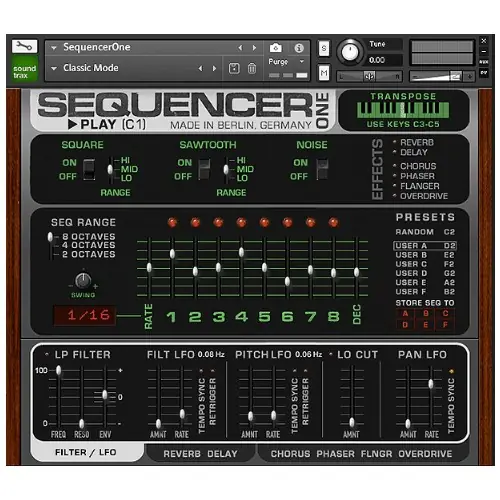
Users trigger the sequencer by clicking a virtual trigger pad, then adjust each of the eight pitch faders to craft their patterns, just as on the hardware. The original lacked precise tuning, but Sequencer One addresses this by allowing the pitch range to be narrowed to two octaves, enabling melodic sequences with exact notes.
Beyond the original square wave, Sequencer One adds two extra oscillators—sawtooth and noise—to expand sonic possibilities. These feed into a filter section and two LFOs for modulation, with six onboard effects for further shaping. This blend of classic workflow with modern flexibility makes it suitable for both retro recreations and new sound design.
Workflow and Signal Flow
Operating Sequencer One follows the original’s hands-on approach: select a pattern by moving the eight faders, choose pitch and decay, and set the speed rate to define rhythmic feel. The modular-style signal path—oscillators, filter, LFOs, effects—mirrors traditional synth architecture, but the sequencer is the heart of the instrument, driving every note.
Because the sequencer is always active, performance is about manipulating the step faders or modulating the filter and speed in real time. This makes it ideal for generative-style sessions where evolving patterns emerge from subtle tweaks. Despite added features, the interface stays true to the original’s minimalistic philosophy, ensuring quick, tactile programming.
Practical Applications
Sequencer One excels at producing rhythmic synth lines, thanks to its eight-step grid and percussive decay options. It shines in techno, electro, and other electronic genres where a driving, raw square wave bass cuts through the mix. Its ability to lock steps to precise pitches also makes it usable for more melodic, chiptune-inspired arpeggios.
The extra oscillators and effects expand its utility beyond the original, allowing for noise sweeps or sawtooth leads layered over the sequence. Sound designers can exploit the LFOs to modulate filter cutoff for evolving textures. While rooted in a legacy design, its modern features make it a versatile tool for contemporary production.
Key features
- Digital recreation of an eight-step CV/Gate sequencer classic
- Iconic raw analog square wave oscillator
- Additional sawtooth and noise oscillators for expanded tone
- Filter, two LFOs, and six onboard effects for sound shaping
- Pitch range adjustable down to two octaves for melodic patterns
- Virtual trigger pad replicates original drumstick activation
- Minimalist interface preserving the hardware’s original approach
Best for
Sequencer One is best for producers and sound designers seeking a faithful yet upgraded version of a rare vintage sequencer. It delivers punchy bass, percussive synth lines, and raw square-wave arpeggios for techno, electro, and retro-inspired tracks, while its added flexibility supports modern sound exploration without losing its iconic character.