Environments is an interactive reverb instrument from AudioThing that turns three historically rich architectural spaces into explorable, playable acoustics through convolution, modulation, and gesture layers.
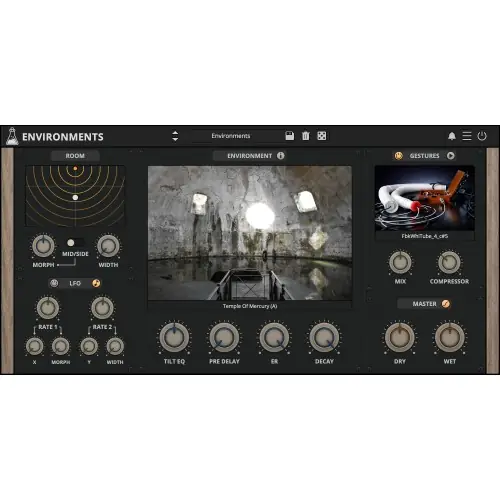
Core Concept
Environments is an interactive experience that treats reverberation as a living, explorable medium. Instead of a fixed simulation, it captures three remarkable real-world locations with unique acoustics and uses a complex convolution engine to combine multiple impulse responses. This gives each space depth and lifelike presence beyond a single static reverb.
The Room section lets you move within the captured environment, reshaping its character as you change position. Modulation adds motion and subtle variation over time, so the acoustic response evolves continuously. The result turns architecture into part of the music, allowing you to play physical space as if it were an instrument rather than just an effect.
Captured Spaces
Three exceptional locations make up the core. The Temple of Mercury in Baia, Italy, is a 1st-century BC Roman thermal hall with a perfect hemispherical dome. Its geometry and water-covered floor allow whispers to echo ethereally, making it a direct acoustic predecessor to the Pantheon.
The Piscina Mirabilis near Naples is the largest ancient Roman cistern, carved from tuff rock with 48 massive pillars. Its five vaulted naves create a vast, resonant interior. The Cisternone of Livorno is a 19th-century Neoclassical reservoir with 128 columns and still water, producing a quiet, temple-like atmosphere. These spaces offer distinct sonic identities for exploration.
Gestures Layer
Gestures adds a second convolution layer before the environment processing. Instead of standard impulse responses, it uses sounds collected on-site with found objects, spare parts, and custom DIY feedback gear from the Spare Parts Sound Project by Salvatore Carannante. This layer introduces resonant textures and rhythmic elements.
Because these gestures are driven by feedback and variations that are never exactly the same, they enable real-time sound design within the environment. You can shape the space’s sonic bands as they evolve, adding a physical sense of contact and unpredictability. Gestures brings texture and rhythm into the reverb, blurring the line between effect and instrument.
Workflow and Applications
Environments fits into a modular workflow: place it on a track, then move through the Room parameter to change position within the chosen space. Modulation adds slow motion, while Gestures allows you to sculpt the sound in real time, creating evolving bands. This is suited for sound design, ambient pads, or adding a physical, three-dimensional quality to any source.
Practical uses include scoring for film or games where the setting matters, creating textural drone music, or designing unique reverbs for instruments that feel grounded in a specific place. It is not a simple reverb for standard mixing; it invites experimentation, treating acoustics as an interactive element. For performers, it turns a live space into a responsive instrument, ideal for exploring unconventional timbres.
Key features
- Complex convolution engine combining multiple impulse responses per space
- Room section for moving within each captured environment and reshaping its character
- Modulation for adding motion and subtle variation over time
- Gestures layer with convolution based on resonant objects and custom DIY feedback gear
- Three real-world spaces: Temple of Mercury, Piscina Mirabilis, Cisternone of Livorno
Best for
Best for sound designers and experimental musicians who want to explore acoustic spaces as instruments, adding responsive, evolving textures to ambient, scoring, or drone work. It suits those seeking a non-traditional reverb that can be played and shaped live, rather than a fixed effect.