A flexible stereo reverb plug-in for professional engineers, offering dual early-reflection and tail paths, full parameter control, integrated 5-band EQ, and over 120 presets for diverse virtual spaces.
Core Function and Design
Oxford Reverb Native is a stereo reverberation generator built for high technical and sonic performance. It avoids fixed algorithms, giving you continuous real-time control over virtually all parameters. The plug-in features dual independent paths for early reflections and reverb tail, which can be used separately or combined to craft spaces from dry ambiences to wide-open halls.
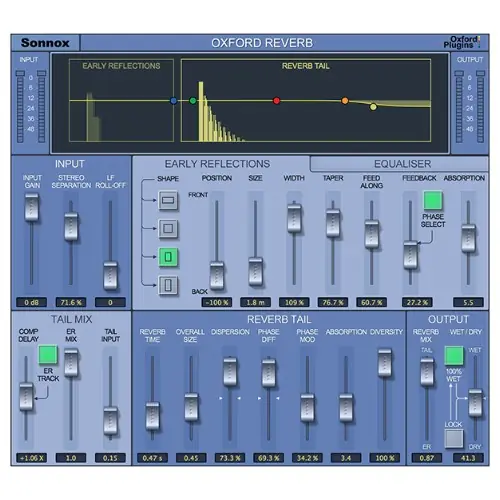
The interface includes dedicated sections for input, early reflections, tail mix, reverb tail, output, and a 5-band EQ. Input controls include gain, stereo separation (full stereo to mono), and low-frequency roll-off that only affects the processed signal. The design supports artistic freedom, allowing engineers to build virtual spaces based on creative needs rather than preset limitations.
Early Reflections and Tail Controls
The early reflections section offers four shape buttons for basic room types. Position places the listening point on a front-to-back axis, while size adjusts room depth with fixed proportions. Width controls stereo separation, and taper shapes reflection loudness relative to path length. Feed along increases density, feedback recirculates signal, phase selects feedback character, and absorption rolls off highs, mimicking soft furnishings.
For the reverb tail, reverb time sets decay to -60 dB, while overall size independently affects density build-up. Dispersion and phase diffusion shape spatial texture, and phase modulation adds temporal variance for realism. Diversity controls front-centre weighting, anchoring the reverb to the centre or spreading it evenly across the stage.
Routing and Output Flexibility
The tail mix section features a compensation delay that sets the tail start time, with an option to track the room size exactly. The ER mix cross-fades between dry input and early reflections output, and the tail input chooses between the delay output and ER mix. This flexible routing lets you layer early and late reflections distinctly.
Output controls include a reverb mix x-fade between early reflections and tail, plus a wet/dry x-fade. The 100% wet button outputs only the reverberation. The integrated 5-band EQ, based on the Oxford EQ, sits before the reverb processor and affects only the wet signal, leaving the dry signal untouched, with bell curves, shelf, and high/low-pass filters.
Workflow and Applications
Working with Oxford Reverb Native involves starting from one of over 120 snapshots categorized as Dry Spaces, Ambient Effects, Vocal Reverbs, Plates, Rooms, Chambers, Halls, Churches, and Foley Effects. From there, you can tweak any parameter in real time to fit the mix. The EQ’s in/out buttons allow easy A/B auditioning of EQ changes.
Typical uses include creating tight reflection ambiences for drums, simulating rooms for dialogue, designing Foley effects, or building lush hall reverbs for vocals and instruments. The wide range of textures—from dry to ultra-wide—supports both subtle placement and dramatic effect. The plug-in is suited for music production, post-production, and sound design where precise control over reverb character is essential.
Key features
- Dual independent early reflections and reverb tail paths
- Continuous real-time control of all reverb parameters
- Integrated 5-band Oxford EQ with high/low-pass and shelf filters
- Over 120 snapshots across ten categories
- Input gain, stereo separation, and low-frequency roll-off controls
- Tail mix with compensation delay and x-fade routing
- Output wet/dry and 100% wet options
Best for
Best for professional engineers and sound designers needing extensive control over reverb shape, from realistic room simulations to creative effects. It suits music mixing, post-production dialogue, and Foley work, where the flexibility of dual paths and detailed EQ lets you craft unique spaces that fit the source material precisely.