RP-Delay is a multi-tap delay effect with six delay lines, a sound reverser, built-in filters and distortion, and extensive modulation options. It offers various routing models and tape simulation, suited for creative sound design and music production.
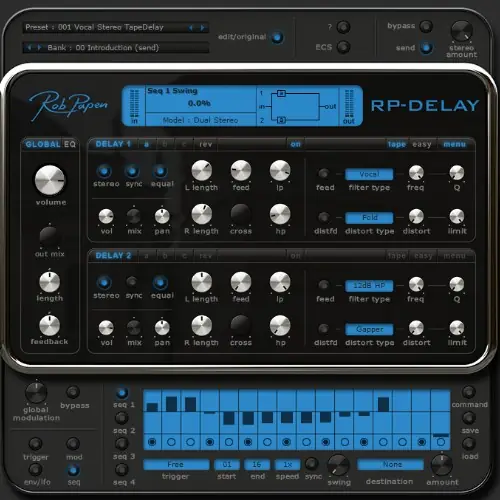
Core Concept and Unique Features
RP-Delay centers on a distinctive sound reverser that can process both the input and individual delay lines simultaneously. This reverser can be triggered via MIDI, enabling performance-oriented effects and the generation of new textures. Each delay line includes its own filter and distortion, allowing for detailed tonal shaping within the feedback loop.
The delay engine supports up to six delay lines, arranged in two groups (A, B, C). These can be configured in multiple routing models, including mono, stereo, dual stereo, channel split, and various serial or parallel configurations. This flexibility supports a broad range of effects, from simple echoes to complex rhythmic patterns.
Delay Models and Sound Design
Beyond basic mono and stereo delays, RP-Delay offers a tape-sound mode that emulates analog tape delay behavior, including variable tape length without clicks. This adds a vintage character to the sound. The delays can be synchronized to the host tempo for rhythmic precision.
Each delay line has controls for time, length, and a multi-mode filter, plus distortion. The routing options extend to full serial and reverse models, enabling unconventional signal paths. The integration of the reverser with the delay lines allows for reversed echoes and complex sound manipulation.
Modulation and Triggering Capabilities
RP-Delay includes a comprehensive modulation system with 8 individual modulators: 4 LFOs, 4 envelopes, and 4 16-step sequencers. The LFOs feature a humanization parameter that randomly varies their speed over time, adding organic movement to the delays.
The sequencers have copy, paste, and file management options for reusing settings. Trigger events can be assigned to MIDI CC controls, and an audio follower can use the input volume as a modulation source. This allows for dynamic, reactive effects that respond to your playing.
Practical Applications and Workflows
In a typical workflow, you might start with a simple stereo delay and then activate the tape mode for a warmer, more analog feel. For creative effects, you can route the delay into the reverser, triggering it via keyboard to produce reversed swells that can be further processed by its filter and distortion.
The sync-to-host feature makes it easy to create tempo-locked echoes for music production. The 5 banks of presets, available for both insert and send use, provide a wide range of starting points, from subtle echoes to wild, modulated soundscapes. This makes RP-Delay suitable for both mixing and sound design.
Key features
- Six delay lines in two groups with multiple routing models
- Built-in sound reverser with MIDI trigger capability
- Tape delay simulation with click-free tape length changes
- 4 LFOs with humanization and 4 envelopes for modulation
- 4 step sequencers with 16 steps, copy/paste, and file management
- Audio follower for processing input volume as a modulation source
- Preset banks for insert and send applications
Best for
RP-Delay is best for electronic music producers, sound designers, and live performers seeking a creative multi-tap delay with unique reversal effects and deep modulation. It is particularly suited for generating evolving textures, rhythmic echoes, and experimental soundscapes, whether in a DAW or in a performance context.