Saurus 4 is an authentic analog synthesizer emulation with True Analog Modeling Technology, offering a wide sonic range, flexible filters, and an advanced arpeggiator in a scalable high-resolution interface.
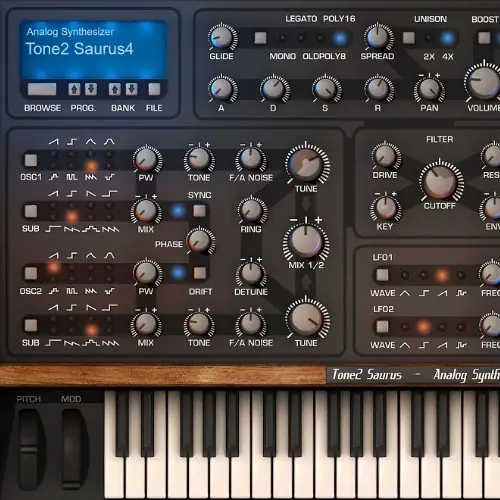
Authentic Analog Emulation
Saurus 4 is a software synthesizer designed to emulate the sound and behavior of classic analog hardware without the typical drawbacks such as high cost or maintenance. It employs True Analog Modeling Technology to produce a warm, characteristic tone reminiscent of vintage synths. The engine operates with 64-bit precision, enhancing audio fidelity, and includes a reworked reverb and improved automatic micro-tuning for a richer sound.
The interface has been completely rewritten in version 4, offering 20 different GUI sizes with or without keys, native support for high-resolution displays up to 8K UHD, and scaling from 66% to 300%. The graphics are sharper with smoother animations and more responsive controls. A patch browser is now accessible via a clickable display, and the demo timeout has been removed, making the full version more convenient.
Key Synthesis Capabilities
The oscillators provide a broad range of waveforms, including standard and exotic types from rare analog synths. Modulation options include PWM, sync, AM, and FM, allowing for a wide variety of sounds. The filter section models classic analog filters with precise non-linearity and self-oscillation, and adds FM, feedback, and analog-modeled distortion for extra grit.
Saurus offers multiple play modes such as mono, legato, glide, poly, stack, and auto-chord, plus a 4x stereo unison for thickened textures. An advanced arpeggiator goes beyond basic steps, featuring custom patterns, chords, swing, and per-step velocity. The modulation system supports drag-and-drop or a matrix, with the ability to modulate almost any parameter at audio-rate speed, and MIDI learn for easy CC assignment.
Workflow and Interface
Designed for intuitive use, Saurus 4 presents a clear interface that scales automatically to the ideal size for the display. The rewritten GUI code ensures reliable resizing across VST3, AudioUnit, and standalone versions. Users can quickly browse presets by clicking the browser or the display, and hover feedback indicates clickable controls.
The modulation matrix simplifies routing dozens of modulation sources to sound parameters. Effects including 4x unison, chorus, delay, reverb, and tube amp complement the synth engine. All effects are of high quality and are intended to be used without placing heavy demands on the CPU, making the instrument suitable for both studio and live performance environments.
Microtuning and Practical Use
Saurus features seven microtuning modes that emulate analog oscillator drift. The engine can slightly detune voices to create fatter, warmer chords. Unlike conventional synths, the microtuning is not limited to a specific tonality; it analyzes melodies in real-time and automatically enhances chords, requiring no manual adjustment.
In practice, Saurus can replace a large number of expensive analog synthesizers, covering a vast sonic range. This makes it useful for sound designers and musicians seeking vintage analog tones without hardware upkeep. With 1022 presets from professional sound designers, it offers immediate inspiration. Its low CPU usage ensures reliable performance in dense mixes.
Key features
- True Analog Modeling Technology for authentic analog sound
- 64-bit audio engine for high sound quality
- 1022 presets from professional sound designers
- Multiple play modes: mono, legato, glide, poly, stack, auto-chord
- 4x stereo unison for thick textures
- Advanced arpeggiator with custom patterns, chords, swing, and per-step velocity
- Modulation matrix with drag-and-drop and MIDI learn
- Seven microtuning modes with automatic chord enhancement
Best for
Saurus 4 is best for music producers, sound designers, and live performers who need authentic analog synth emulation without hardware costs. Its broad sonic palette and flexible modulation make it suitable for creating vintage-style leads, basses, pads, and arpeggios, while the low CPU load supports complex productions and real-time use.