Tracktion Atmosia is a four-voice atmospheric synth for cinematic sound design. It combines over 700 sources, deep modulation, an X/Y pad, and 28 effects.
Core Concept
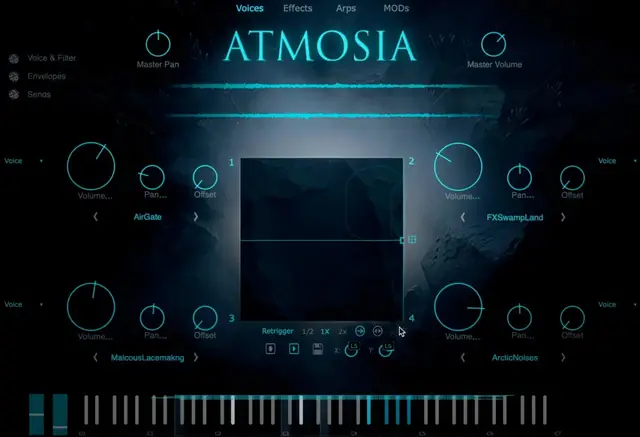
Atmosia is a four-voice atmospheric engine designed for film, TV, advertising, video games, ambient, and experimental music. Each voice can host one of over 700 sound sources, from fragile textures to dark, haunting tones. The instrument simplifies complex sound design into single-note performances, but retains deep per-voice editing for detailed sculpting.
A redesigned, minimalist interface places all voice-editing tools on a single front page. Envelopes, filters, modulation, and effects are instantly accessible without navigating hidden menus. The tag-based browser allows fast auditioning of samples within the four voices, and custom tags can be created to personalize the library.
X/Y Pad and Modulation
The iconic X/Y pad lets you morph between four sound sources by drawing movement paths in real time. Paths can be recorded with a click and visualized directly on the pad. New horizontal and vertical offset controls let you shift the path anywhere on the plane, and these offsets are fully modulatable.
The static timer has been replaced by a Transit Modulator (LFO) that syncs to your DAW’s tempo. You can choose musical intervals like eight bars or half-bar, and select waveforms from sine, triangle, random, or custom shapes. One-shot, ping-pong, and free-run modes are available, plus retriggering.
Effects and Arpeggiators
The FX engine expands from 8 to 28 effects, including custom modules that twist and warp sound. Four send slots and four master slots are available, each hosting any of these effects. A new ring-modulation filter adds metallic sheen, and the Field effect uses convolution with over 50 custom impulse responses.
Per-voice arpeggiators now offer multiple play directions, chord-based playback, and a note-trigger probability for random notes. Each core parameter—volume, pan, pitch, filter frequency, resonance—has a dedicated LFO. Those LFOs can be speed-modulated by secondary sources, and six freely assignable Mod LFOs allow routing to other LFOs.
Workflow and Presets
Randomisation is grouped into independent categories: Voice & Filter, Envelopes, Sends, Effects, and Arps. You can dial in chaos in specific areas while keeping others stable, exploring thousands of variations with a single click. The Drone engine provides static or MIDI-responsive drones that can lock in ambient beds.
Over 330 presets are organized with the same tag-based system for sorting and searching. You can build signature setups and save them. The browser loads samples directly into any of the four voices, and you can customize tags to match your workflow, making sound discovery quick and intuitive.
Key features
- Four-voice architecture with over 700 sound sources
- One-page interface for all voice editing
- X/Y pad with recordable and offset-modulatable paths
- 28 effects with four send and master slots
- Per-voice LFOs with meta-modulation
- Independent randomisation for groups
- Tag-based browsing for sounds and presets
Best for
Atmosia excels in cinematic and ambient sound design for film, TV, and games. Its single-note playability and deep morphing make it ideal for evolving textures, pads, drones, and unsettling soundscapes. Producers seeking expressive, modulatable atmospherics will benefit from its unique routing and randomization.