SEQ-ST is a creative equalizer with direct-draw curves, spectrum analysis, mid/side processing, EQ matching, and automated morphing for precise corrective work and expressive sound design.
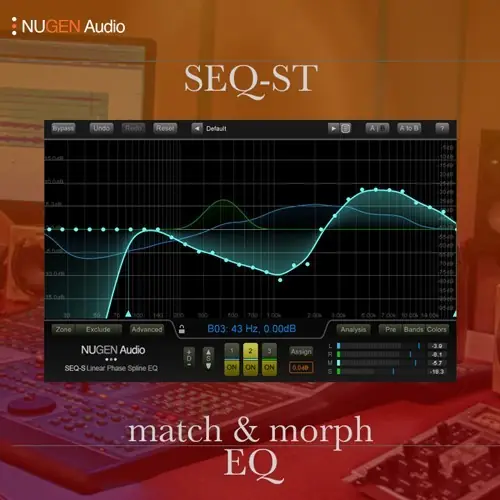
Core Purpose
SEQ-ST brings a new approach to equalization, offering a direct-draw interface alongside detailed spectrum analysis. This combination lets audio engineers identify problem areas quickly and apply fine-tuned corrections with resolution beyond typical parametric controls. The interface adapts to the task, allowing simple adjustments or sophisticated shaping depending on the project’s needs.
Its design avoids phase warping or smearing, which helps retain the original character of the sound. With facilities for node locking, zoomable views, and multiple curve display options, the tool supports precision work without compromising the overall signal integrity, making it suitable for critical listening and mixing environments.
Key Capabilities
A standout feature is automated EQ morphing, which transitions between two EQ states over time. This allows for fluid filter morphs, enabling controlled scene changes or creative sound design sweeps. Users can set up independent transition pairs including dynamic and static pass filter effects, all with full visual feedback to track the movement.
The match EQ function captures the tonal character of source audio and applies it to another track, useful for restoration or harmonizing different takes. The invert function samples a curve and applies its inverse, creating space in a mix without heavy-handed processing; it is especially effective for carving out a place for dialogue against a busy backing.
Workflow
For music production, SEQ-ST provides detailed envelopes for fine-tuning beyond traditional EQ. Engineers can use EQ matching to gently steer a mix toward a reference or explore creative morphing with tempo-locked effects. Independent left/right and mid/side modes let users direct equalization precisely where it is needed, ideal for corrective mixes or mastering polish.
In post and broadcast, the flexible nodes and drawing interface speed up specific corrections that would otherwise be time-consuming. The match-invert technique is quick for finding dialogue space, avoiding intrusive frequency cuts or aggressive ducking. Automated morphing can be used for scene transitions or sound design, relying on two stored EQ memories for smooth changes.
Practical Applications
Use SEQ-ST to correct and massage any audio with exceptional resolution, addressing narrow resonances or tonal imbalances that conventional parametric EQs struggle to isolate. It also supports creative tasks like dynamic filter sweeps or morphing between different room acoustics in a mix, all while maintaining phase integrity.
For restoration and harmonization, the match function can unify disparate microphone positions or takes, bringing consistency to a recording. The invert method offers a minimally invasive way to create space in dense arrangements, ensuring dialogue or lead elements stand out naturally without affecting the underlying tonality.
Key features
- Direct-draw EQ curve with detailed spectrum analysis
- Automated EQ morphing with up to three transition pairs
- Match EQ to copy the character of a source
- Invert function to create space in a mix
- Mid/side and left/right processing
- Zoomable interface with node locking
- No phase warping or smearing
Best for
Audio professionals in music mixing, mastering, and post-production who need precise EQ correction, creative morphing effects, or a way to match and adapt tonal character without phase artifacts.