A polyphonic vocoder effect and instrument inspired by the EMS 5000, with dual synthesizer cores, 22/20-band filter banks, matrix patching, and advanced modulation for voice and sound processing.
Purpose and Core Design
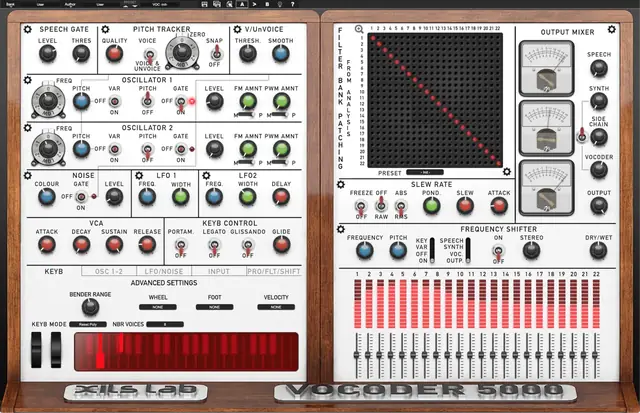
The XILS-lab Vocoder 5000 emulates the architecture of the legendary 1976 EMS 5000 analog vocoder, known for its complex circuitry and organic sound. It accepts an external audio source, such as a voice or instrument, and processes it through a bank of filters controlled by a built-in synthesizer, allowing you to reshape the input dramatically.
The software provides two synthesizer cores, each with two VCS3-modelled oscillators, a noise generator, two LFOs, and a VCA-ADSR envelope. You can feed a microphone, musical instrument, or prerecorded signal into the vocoder, then use the virtual keyboard to alter pitch, tone, and vibrato, transforming spoken words into melodic phrases or crafting a choir from a single voice.
Key Capabilities and Filtering
Central to the Vocoder 5000 are two dedicated filter banks: a 22-band and a 20-band vocoder filter bank, both available for analysis and synthesis. Each band can be configured with selectable filter types and adjustable emphasis, with controls for emphasis weighting to shape the character precisely. The input detector includes a voice/unvoiced detector and an input gate to suppress noise between phrases.
You can use the sidechain input to add an external audio source to the carrier signal, rather than relying solely on the internal synthesizer. The filter banks can be used in stereo mode, and the frequency shifter effect adds further tonal transformations, giving you a flexible toolbox for creative sound design.
Workflow and Modulation Matrix
A large matrix patch area (22×22 or 20×20) mirrors the classic EMS patching system, allowing you to route signals and modulation freely by drawing lines. This matrix can be saved as presets, ideal for storing a template that works with a specific voice or set of parameters. The interface presents a single-panel view for beginners, but a central logo panel reveals advanced modules for deep editing.
Beyond the original hardware, XILS-lab added extensive modulation options: two LFOs per core (the original had none), more slew rate and freeze modes, detailed FM and PWM, and extra oscillator waveforms. All parameters are MIDI-controllable, making it easy to automate the vocoder in real time or from a DAW.
Practical Applications for Sound Design
You can process voice to create clear, intelligible speech effects in multiple languages, or use it to harmonize spoken text into chordal patterns. For drums and percussion, the vocoder can inject analog character or carve new timbres from rhythm loops, even deriving pure synth patterns. Guitars and other synthesizers can be fed in to broaden their tonal palette.
For experienced users, the deep parameter set supports complex modulation routings and experimental FM/PWM, while the output mixer and frequency shifter enable precise tone shaping. The included presets offer a starting point for classic vocoder sounds, but the matrix and advanced panels let you build entirely novel setups.
Key features
- Dual synthesizer cores with two VCS3-modeled oscillators each
- 22-band and 20-band vocoder filter banks with selectable filter types
- Matrix patch area (22×22 or 20×20) for flexible routing
- Voice/unvoiced detector and input gate for noise reduction
- Sidechain input for external carrier sources
- Two LFOs per core with slew rate and freeze modulation modes
- Full MIDI control over all parameters
Best for
Vocoding vocals and instruments into melodic or percussive textures, especially when you need a rich, analog character with deep patching options. Suitable for experimental sound design, classic vocoder effects, and adding movement to drum loops or guitar parts.