Softube Harmonics is a distortion plug-in with five component-modelled analog styles and Dynamic Transient Control to preserve attack and dynamics while adding saturation.
Purpose and Core Concept
Softube Harmonics addresses the common problem of distortion flattening dynamics and dulling transients. It offers five distinct component-modelled distortion styles derived from analog processes like tubes and transformers. The plug-in’s key innovation is Dynamic Transient Control, which analyzes the input signal’s dynamics to decide how much transient content survives distortion.
This approach lets you add grit, edge, or saturation without sacrificing the natural attack and decay of your source. It’s designed for music producers and mix engineers who need more attitude from tracks but want to avoid the washed-out, lifeless results typical of heavy distortion. Harmonics aims to give you control over the balance between drive and clarity.
Key Capabilities
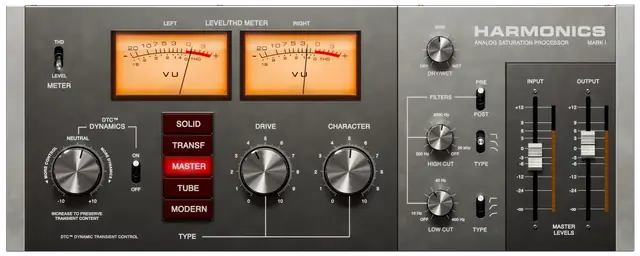
The plug-in includes five distortion types named Solid, Transf, Master, Tube, and Modern. Each delivers a different color and behavior, from subtle transformer warmth to aggressive tube saturation. Drive Amount and Drive Character knobs let you control saturation level and tonal color independently. A dry/wet mix knob enables parallel processing without extra routing.
High and low cut filters offer three slopes each and can be placed before or after the distortion stage. An input level fader and output level fader allow precise gain staging. A THD meter displays total harmonic distortion for fine-tuning subtle saturation, while left and right VU meters show level or THD.
Workflow and Control
In a mixing session, you insert Harmonics on a track and select a distortion style. Set Drive Amount for the desired intensity, then adjust Character to shape the tone. Use the pre/post filters to tailor frequency content before or after saturation, helping to avoid muddiness or harshness. The wet/dry knob lets you blend the distorted signal with the clean original.
The THD meter guides you when adding gentle saturation, ensuring consistent harmonic content across different sources. Input and output faders help match levels to prevent clipping or level jumps. Dynamic Transient Control works in the background, analyzing incoming dynamics to preserve attack. This makes it easy to maintain punch on drums, clarity on vocals, and definition on bass.
Practical Applications
Use Harmonics to add grit to electric guitars, make vocals more aggressive, or give drums extra snap without losing their transient response. The parallel mix and filter options make it suitable for subtle bus saturation on an entire mix or for sound design on synths. The five distortion types cover a range of tonal possibilities, from transparent warmth to heavy drive.
The included presets by Grammy-winning engineers Joe Chiccarelli and Howard Willing provide starting points for different sources and styles. Whether you need a gentle harmonic exciter or a full-on distortion effect, Harmonics offers a flexible toolkit. Its dynamic preservation sets it apart for material where maintaining dynamics is critical, such as rock, pop, or electronic productions.
Key features
- Five component-modelled distortion styles: Solid, Transf, Master, Tube, Modern
- Dynamic Transient Control preserves attack and dynamic range while distorting
- Drive Amount and Character controls for saturation level and tone
- Dry/wet blend knob for parallel processing
- High and low cut filters with three slopes, placeable pre or post distortion
- THD meter and VU meters for level and harmonic distortion monitoring
- Input and output level faders for gain staging
Best for
Best for adding drive to drums, guitars, vocals, bass, or synths while keeping transient detail intact. Also suits mix engineers needing parallel saturation or a range of distortion colors from subtle warmth to heavy grit, with presets from pro engineers for quick starts.