Arguments is a vintage-style test equipment plugin that combines two audio signals through analog-inspired math, offering tone generation, distortion, filtering, and unpredictable textures for experimental sound design.
Core Concept
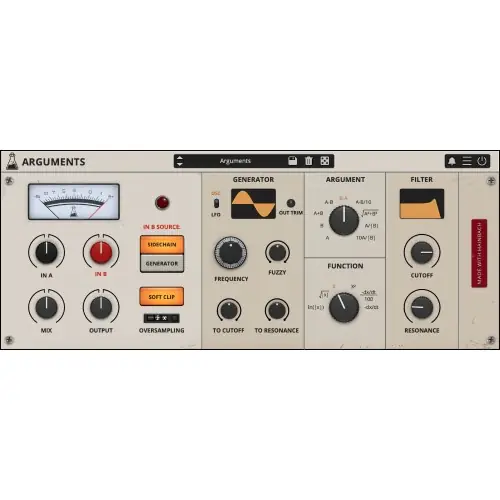
Arguments is a dual-signal processor that takes input A and either external side-chain input B or its internal generator, then combines them using one of nine mathematical argument modes. The result passes through a function block with six processing options, followed by a multimode filter for shaping.
The plugin is modeled on analog nuclear instrumentation modules from the NIM BIN era, re-tuned for musical use. Every stage uses analog modeling to capture the character of vintage hardware, producing dynamic and often unpredictable results. Each part can run independently, so it functions as a rich test tone generator, complex distortion unit, or multimode filter.
Key Capabilities
The argument block offers modes like A+B, A-B, A⋅B/10, √(A²+B²), and A/|B|, each creating distinct interactions between the two signals. The function stage includes options such as natural logarithm, square root, square, and two derivative-based modes (-dx/dt) that produce complex waveshaping effects.
A multimode filter allows precise tonal shaping and modulation. The plugin includes oversampling as a sonic texturing tool—lower settings add fizzling high-end frequencies, while turning it off yields aggressive industrial fuzz, especially with derivative functions. A built-in LFO generator can modulate the filter or serve as a rhythmic accent shaper when synced to a drum beat.
Creative Workflow
Side-chain operation is supported, but requires DAW-specific setup. Rhythmic material, simple sounds, and two pinged filters all produce massive results when combined. For example, feeding a Rhodes and a drum loop through the plugin yields a smashing hybrid texture.
The most interesting sounds emerge when the math ‘fails’—by adjusting input gains near the threshold of signal disappearance, you get overloaded op-amp tones reminiscent of rare vintage gear. Mapping input gains to MIDI controllers allows playful manipulation of the gain staging. The preset system includes a randomizer for quick exploration, with presets like ‘Industrial Love’ and ‘Harsh Noise Shred’ as starting points.
Practical Applications
Use Arguments as a test tone generator with the internal sine oscillator, or as a distortion unit for adding grit to drums, bass, or vocals. It works well for creating rhythmic modulations by syncing the LFO to a beat and adjusting waveforms and phase offset.
For vintage electronic music vibes, set up multiple instances with different sine tunings and mix them externally, adding drift for a failing-unit character. A locked-in patch technique uses bandpass filtering with high resonance swept through a crackling signal mixture to emulate a lock-in amplifier, producing tonal pings. Another recipe mimics the PAR CR4A by using B-A, sample-and-hold, and differentiation for a dry, crisp, Geiger-like effect.
Key features
- Analog modeled oscillator with sidechain or generator mode
- Nine argument modes for signal combination
- Six function blocks including log, square root, and derivatives
- Multi-mode filter for shaping and modulation
- Oversampling control for texture and fizz
- LFO generator for rhythmic shaping
- Preset system with randomizer
- Resizable window with brightness and contrast controls
Best for
Best for sound designers and experimental musicians seeking chaotic, vintage-inspired textures, from industrial distortion to psychedelic Klangmixturen. It shines on rhythmic sources, drum loops, and simple waveforms, offering unique results through hands-on gain staging and filter sweeping.