Objeq Delay 2 is a physical-modeling delay effect by AAS, blending classic echo techniques with acoustic resonances. It features four delay topologies, dual modulators with six sources, a morphable Objeq filter, and psychoacoustic panning for evolving, responsive effects.
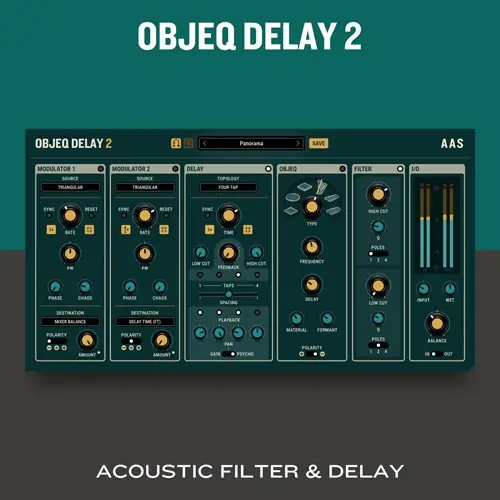
Core Delay Engine
Objeq Delay 2 offers four distinct delay topologies—one-tap, two-tap, four-tap, and split—to cover a wide creative range. One-tap provides simple echoes, while two-tap and four-tap introduce animated multi-tap textures and staggered rhythmic patterns. Split mode offers a different stereo or routing path.
These topologies allow everything from subtle rhythmic support to bold transformations. The delay engine is built on physical modeling, distinguishing it from typical digital delays. Each topology serves as a different starting point for sound design, whether you need clean repeats or intricate, evolving patterns.
Dual Modulators
The dual modulators are designed for flexible and performance-responsive effects. Each modulator can be configured independently, and they can be combined to create complex modulation chains. You have access to six modulation sources: rectangular, triangular, and sine LFOs offer rhythmic motion, while RMS, envelope follower, and monophonic pitch tracking respond to level and pitch.
This combination allows delay parameters to evolve with the input signal. For example, pitch tracking can make delay times or filter cutoff follow the melody, while the envelope follower adds dynamic movement. This makes the effect feel alive and interactive, suitable for performance and studio use.
Objeq Filter and Tonal Shaping
The Objeq filter is a morphable acoustic module that can switch between plate, beam, drumhead, and string responses. This provides a wide range of resonant colors, and a polarity switch reveals alternate voicings and tonal contours. It acts as an expressive sound-shaping instrument, not just a simple filter.
Additionally, dual low and high-cut filters with adjustable Q and slope options (1, 2, or 4 poles) allow precise tonal sculpting. You can tighten lows, smooth highs, and emphasize resonance. This gives you control over the weight, presence, and clarity of the delayed signal, making it easy to fit into a mix.
Psychoacoustic Panning and Interface
Psychoacoustic panning uses arrival time and spectral cues to place sounds in the stereo field, resulting in a subtle, immersive, and natural response. This technique enhances the spatial dimension of the delay without being aggressive, which is particularly useful for creating depth.
The user interface is brand new, designed for efficient workflow. A new library with over 100 presets provides a starting point for various styles. Additionally, a third modulator and three new modulation sources have been added, plus a new Objeq module, expanding the possibilities for modulation and sound design.
Key features
- Physical-modeling delay with four topologies: one-tap, two-tap, four-tap, split
- Dual modulators with six sources: LFOs, envelope follower, RMS, pitch tracking
- Morphable Objeq filter with plate, beam, drumhead, string responses, and polarity switch
- Dual low/high-cut filters with adjustable Q and 1, 2, or 4-pole slopes
- Psychoacoustic panning for immersive stereo imaging
- New user interface and library with over 100 presets
Best for
Objeq Delay 2 suits sound designers and electronic musicians seeking distinctive, responsive delay textures. It excels in creative sound design, cinematic effects, and live performance where modulation can be driven by dynamics or pitch. The acoustic filter design makes it suitable for adding organic resonance to synthesized or sampled material.